
Dispatch
When Trust Is No Longer Needed: The Concrete Future of A Quantum Payment System
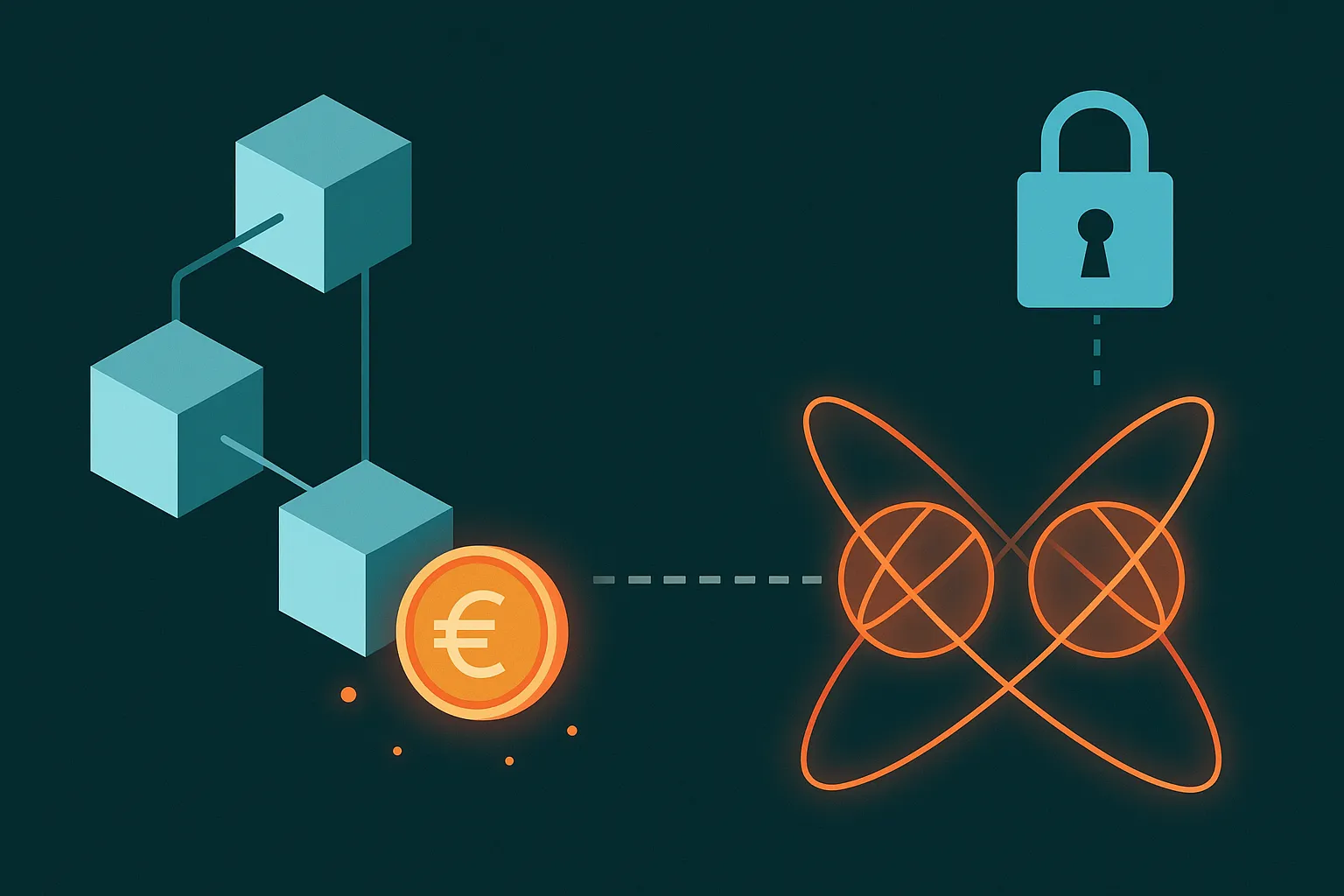
Quantum mechanics could revolutionize payment systems by making cooperation and trust emerge as physical properties rather than mathematical guarantees, eliminating the need for distributed consensus networks.
Contents
There’s a phrase that often circulates among physicists and computer scientists, half joke and half prophecy: “One day, trust will be a property of matter.”
It sounds philosophical, but it’s not.
Quantum mechanics — that same theory describing particles existing in two states at once — is showing that cooperation can emerge even without trust or communication.
And we’re not just talking about thought experiments: we’re talking about a physical principle that could rewrite the way we exchange value, information, and digital contracts.
At the heart of this idea lies something the blockchain has been chasing all along: a system where trust is unnecessary because it’s guaranteed by the structure of the universe itself.
Entanglement and the Birth of “Trustless” Cooperation
The starting point is a thought experiment as famous as it is simple: the Prisoner’s Dilemma.
Two suspects are interrogated separately: if both remain silent, they go free; if one betrays, they gain at the other’s expense; if both betray, both lose.
Rational logic pushes them to betray — it’s the nature of distrust.
In the 1990s, however, three researchers — Jens Eisert, Martin Wilkels, and Maciej Lewenstein — decided to rewrite the game in quantum terms.
Instead of binary choices (cooperate or defect), each player was given a qubit, a particle in a superposition state that could represent both choices simultaneously.
And crucially, the two qubits were entangled — linked by a quantum correlation so deep that describing one without the other became impossible.
The result? Under certain configurations, players could no longer maximize their individual gain by defecting. Cooperation became the rationally optimal strategy, because entanglement tied their fates together.
No trust, no communication — yet cooperation emerged as a built-in property of the physical system.
At first glance, it may seem like a theoretical curiosity. But behind it lies a profound insight: cooperation can be engineered, if we design the right structure of correlations.
When Physics Meets Economics
Digital economics — especially that surrounding blockchain — is built on the very same principle: creating trust among strangers.
Today, we do it with mathematics.
Smart contracts on Ethereum, for instance, execute automatically, ensuring that neither party needs to trust the other.
But for this to work, we need a complex infrastructure: nodes, consensus algorithms, validators — and, above all, energy.
A quantum system of exchange suggests something radically different: don’t trust the network, trust the physics.
Instead of thousands of replicated ledgers, each “coin” would be represented by a unique, unclonable quantum state.
The no-cloning theorem — one of the cornerstones of quantum mechanics — makes it impossible to copy an unknown state.
In practice, double-spending would become physically impossible, not merely computationally improbable.
The idea isn’t new. Back in 1983, physicist Stephen Wiesner at Columbia proposed a “quantum money” system where each banknote was made of photons polarized in secret directions, impossible to duplicate.
Decades later, Scott Aaronson and Paul Christiano formalized more modern versions — such as the hidden subspace schemes — allowing publicly verifiable quantum money.
These theories are slowly leaving academia.
In 2021, a research group at the University of Cambridge tested a prototype quantum token using photons, while the UK-based company Quantinuum began exploring quantum authentication protocols for banking and supply chain applications.
Blockchain Today: Algorithmic Security, Energy, and Consensus
Blockchain, as it stands today, is an elegant but costly compromise.
To remove trust, it requires a distributed network of nodes validating every transaction via consensus algorithms (like Proof-of-Work or Proof-of-Stake).
The price of that security is well known: energy consumption, latency, and limited scalability.
Which leads to the obvious question: what if security no longer came from consensus, but from the laws of nature?
A well-designed quantum system could ensure uniqueness, integrity, and authenticity without redundant computations or multiple validators.
There would be no need to “make everyone write the same history” on a shared ledger — the history itself could not physically diverge.
This is the idea behind Quantum-Secured Blockchain, where the network remains classical but its security is reinforced by Quantum Key Distribution (QKD).
QKD uses photons to transmit cryptographic keys that cannot be intercepted or copied.
China has already implemented it across a 2,000-kilometer backbone (Beijing–Shanghai) and, since 2017, via the Micius satellite, distributing quantum keys between continents.
In Europe, the EuroQCI (European Quantum Communication Infrastructure) project aims to build a similar system by 2030, with applications for banks and public institutions.
From “Quantum-Secured” to “Quantum-Native”
Right now, we’re in a transition phase: the goal is to make classical blockchains resistant to future quantum computers, which could eventually break today’s cryptographic schemes (RSA, ECC).
In 2024, the U.S. NIST published the first post-quantum cryptography standards (ML-KEM, ML-DSA, SLH-DSA), which have already been adopted in Europe and parts of Asia.
It’s the seatbelt for this in-between stage: classical blockchains, but armored against quantum attacks.
The real breakthrough will come with quantum networks — fiber or satellite channels capable of maintaining entanglement on a geographic scale.
For that, we need quantum repeaters: devices that “regenerate” entanglement without measuring or destroying the states.
They’re the quantum equivalent of optical repeaters — the missing link to build a truly global quantum internet.
Once these networks become operational, the next step will come naturally: replacing parts of distributed consensus with direct quantum correlations between nodes.
This is the concept behind quantum blockchain, first theorized in 2018 by Ying Li, Ming Yang, and Jian Chen (“Quantum Blockchain: A Secure Future”), and now being explored at research centers like the Cambridge Quantum Network and QuTech Institute in the Netherlands.
An Evolution, Not a Revolution
Talking about “quantum blockchain” doesn’t mean erasing everything we’ve built so far.
It means shifting the idea of trust to a deeper level — from mathematics to physics.
It’s a gradual path:
- first, classical blockchains that are quantum-proof;
- then hybrid systems using QKD for key transmission;
- and eventually, natively quantum protocols where every transaction is a unique, irreversible physical event.
When that happens, the term trustless will take on a new meaning.
It won’t mean “without trust between humans,” but “without physical possibility of betrayal.”
In a sense, cooperation itself will become an emergent property of reality.
Not Science Fiction — Applied Physics
Many scientists remain cautious, but few still laugh at the idea.
Research is advancing fast, and the line between theory and engineering gets thinner each year.
In China and Switzerland, quantum banking channels are already being tested.
In Canada, D-Wave and Xanadu are experimenting with consensus algorithms on quantum hardware.
The European Union continues to fund major programs like Quantum Flagship, focused on industrial-scale quantum components.
All of this suggests that the next generation of blockchain won’t be built to replace today’s ecosystem, but to bring trust back to where it truly belongs — into the structure of matter itself.
Recommended readings
- Eisert, J., Wilkens, M., & Lewenstein, M. (1999). Quantum Games and Quantum Strategies. Physical Review Letters, 83(15), 3077–3080.
- Wiesner, S. (1983). Conjugate Coding. ACM SIGACT News, 15(1), 78–88.
- Aaronson, S., & Christiano, P. (2012). Quantum Money from Hidden Subspaces. Proceedings of STOC 2012.
- Li, Y., Yang, M., & Chen, J. (2018). Quantum Blockchain: A Secure Future. Frontiers in Physics.
- Liao, S. et al. (2017). Satellite-to-ground quantum key distribution. Nature, 549(7670), 43–47.
- NIST (2024). Post-Quantum Cryptography Standards (FIPS 203, 204, 205).
- European Commission (2023). EuroQCI: European Quantum Communication Infrastructure Roadmap.
Originally published on Medium.